On September 13, 2026, my old friend and fellow Naval Aviator, Pete Peterson, emailed the text of an article, “We Must Pace the Frontier,” by Dario Amodei, September, 2026, with the note: “This is a long read, but it may be the most important thing you will read this year.” Here is the link to Amodei’s article: https://darioamodei.com/post/we-must-pace-the-frontier.
I wrote back: “Thanks, Pete,
It’s going to take some time for me to digest all of this, if indeed I even can! As you know, I am no stranger to computer technology. I wrote my first program in 1962, and that was in assembly language without the benefit of a compiler. I suffered through the pain of trying to convince managers to use exception reporting and old-school accountants to discard their green eyeshades. I linked systems using voice-grade telephone lines. And yes, even today, I keep my friendly AI Copilot close at hand while I am composing to verify facts.
Since the discovery of fire and the wheel, mankind has resisted change. The thing called artificial intelligence is the next iteration. It’s going to be interesting to see how it all shakes out. We probably won’t be around to see the final chapter. So, take a seat and enjoy the show while we last!”
Lash (My old call sign)
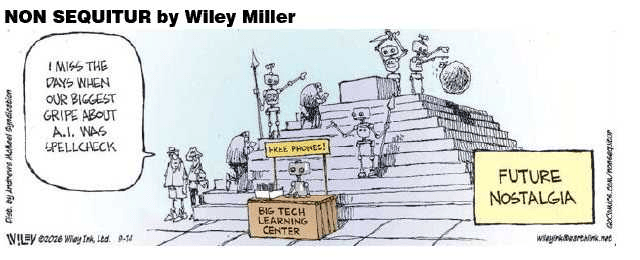
Since then, the news media has been filled with the Artificial Intelligence debate. It seems that Amodei’s article has struck a note, and everybody from activists to scientists to politicians to environmentalists to pundits to evangelists to the common man is weighing in. But fear not, from the Stone Age to the Agricultural Age to the Industrial Age to the Information Age, mankind has exhibited a remarkable capacity to survive. As Robert Browning said in his 1864 poem Rabbi Ben Ezra: “Grow old along with me! The best is yet to be.” https://poets.org/poem/rabbi-ben-ezra
In 1945, the LaRue family leaves California and moves to the bucolic world of Northeastern Oregon.
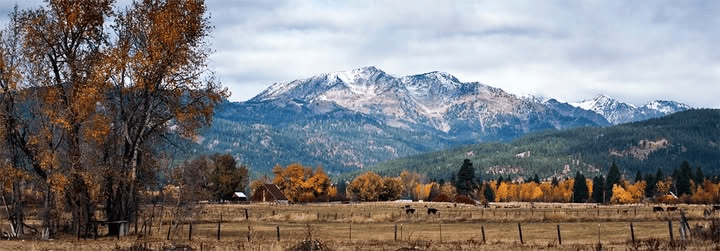
The Wallowa Mountains dominate the landscape of Oregon’s northeast corner. The Nez Perce Indians called this country The Land of Winding Waters. With the arrival of European settlers, these craggy mountains and picturesque valleys came to be known as the American Alps. To the east of the mountains, the Snake River slices through North America’s deepest river gorge, Hells Canyon. Nestled in one of the valleys above the canyon’s rim, the little town of Halfway is our destination.
Before Halfway, however, we make a stop at Nampa, Idaho. An old friend and fellow worker from McMullan’s Dairy had established a farming operation there. Dad wants to visit with his friend and check out the area.
Our host saddles a horse for me to ride. It is my first experience riding a real working saddle horse, and I am hooked. I spend every waking hours riding around the ranch until we leave.
The road leading from Nampa to Halfway follows along the old Oregon Trail to Baker, Oregon. Pioneers in covered wagons followed the same route starting in the 1840s. The route runs along the Snake River to a place called Farewell Bend. At Farewell Bend, the Snake turns north into Hells Canyon. The Oregon Trail, now called Highway 30, forks off northwest through the Burnt River canyon up to Baker Valley. We, pioneers of the 1940s, follow this historic route in our 1937 pickup truck.
From Baker, we turn east for the next sixty miles to our destination, Pine Valley. We cross the still visible wheel ruts of the Oregon Trail running through a dry sage-covered plain of Virtue Flat. The dry landscape gives way to a stretch of lush green irrigated pastures and farmed fields. The paved road turns into gravel. Passengers in occasional oncoming vehicles wave a friendly greeting as we pass. We seem to travel through time to an earlier era. Cowboys and ranchers still tend their cattle on horseback. Stout draft horses still draw farm implements. The twentieth century has largely eluded the countryside.
The road unexpectedly changes back to pavement. The landscape changes to a narrow canyon. We follow the Powder River through deep cuts and winding turns to Eagle Valley. Eagle Valley reveals another landscape of green pastures and farmed fields. We pass through the small cluster of homes and businesses called Richland. The valley closes back to a narrow canyon as we approach the Powder’s confluence with the Snake.
A lettered road sign points left toward Halfway. We follow the sign and climb a steep grade with sharp switchbacks. Our loaded pickup grinds along in low gear. We top the hill and travel down through a wide swale. Cattle graze on the dry yellow grass below farmsteads set back against the hills. The yellow landscape turns to green, and Pine Valley opens before us.
We turn left at an intersection near a sawmill and follow the valley’s only paved road to Halfway. Halfway boasts a bank, two grocery stores, two bars, several churches, three gas stations, a drug and liquor store, and other related businesses. The Gray Gables Hotel houses one of the bars and offers rooms to rent. Three housekeeping cabins behind a white picket fence and a manicured green lawn flank one side of the hotel. We rented one of the cabins and set up housekeeping. It is a welcome relief to get off the road and out of the cramped pickup cab.
My eight-year-old mind does not grasp the significance of our travels. At eight, you do not question your parents’ actions. You accept whatever they do as the norm. Even so, I could sense that this small world was a complete change from the world I had experienced in California. My dad’s motivation will always remain a mystery. Perhaps he was a throwback to his grandparents’ generation. Perhaps he was a precursor to the counterculture of the 1960s. Maybe he just wanted to escape the controls that a wartime culture had placed on society. The cold, hard facts were that we had arrived in the strangely named little town of Halfway, Oregon, and there I would remain for the next ten years until I graduated from high school. My Post-War Home Front had just begun.
Four days after I posted the August 24 article relating the removal of historic statues to Orwell’s distopic novel, 1984, the government of Virginia proceeded to remove statues of Stonewall Jackson and two other southern icons from the capitol grounds in Richmond. https://www.youtube.com/shorts/ggnEocZzTzk?feature=share Follow the links for videos. https://www.youtube.com/watch?v=Z6OlpAvWGco. “Who controls the past controls the future. Who controls the present controls the past.” George Orwell, Nineteen Eighty-Four.
Monument to Confederate dead, Arlington National Cemetery, Arlington, Va. (Universal History Archive/Universal Images Group via Getty Images)
Here’s a little note I penned in 2023.
In George Orwell’s dystopian novel, “Nineteen Eighty-Four,” the main character, Winston Smith, is a member of the Outer Party who works at the Ministry of Truth, where he rewrites historical records to match the state’s ever-changing version of history. Winston revises past editions of The Times, while the original documents are destroyed when they are dropped into ducts called memory holes that lead to an immense furnace. He secretly opposes the Party’s rule and dreams of rebellion, even though he knows he is already a “thought criminal” and will likely be caught one day.
In today’s real world, Defense Secretary Lloyd Austin on Thursday signed off on an independent commission’s recommendations to rename military bases that honor Confederate officers and scrub a long list of references commemorating the southern rebellion.
The Naming Commission, established by Congress last year, inventoried all the military’s current references to the Confederacy. It found nine Army bases and several buildings commemorating rebel officers, as well as a monument honoring Confederate soldiers at Arlington National Cemetery.
“The names of these installations and facilities should inspire all those who call them home, fully reflect the history and the values of the United States and commemorate the best of the republic that we are all sworn to protect,” Austin, the first Black defense secretary, said in a statement in which he said he agreed with the commission’s recommendations.
The following nine bases are scheduled to be renamed:
Fort Benning, Georgia — Fort Moore
Fort Bragg, North Carolina — Fort Liberty
Fort Gordon, Georgia — Fort Eisenhower
Fort A.P. Hill, Virginia — Fort Walker
Fort Hood, Texas — Fort Cavazos
Fort Lee, Virginia — Fort Gregg-Adams after two Black service members, Lt. Gen. Arthur Gregg, a supply logistician who helped desegregate the Army, and Lt. Col. Charity Adams, who oversaw mail distribution in Europe during World War II
Fort Pickett, Virginia — Fort Barfoot
Fort Polk, Louisiana — Fort Johnson after Sgt. William Henry Johnson, a Black soldier in World War I who was awarded the Medal of Honor in 2015
Fort Rucker, Alabama — Fort Novosel after Chief Warrant Officer 4 Michael J. Novosel Sr., an Army aviator during the Vietnam War who flew 2,543 extraction missions and rescued more than 5,500 wounded soldiers
“Every record has been destroyed or falsified, every book rewritten, every picture has been repainted, every statue and street building has been renamed, every date has been altered. And the process is continuing day by day and minute by minute. History has stopped. Nothing exists except an endless present in which the Party is always right.” (Orwell, George. 1984. New York: Signet Classic, 1950.)
(Author’s note: The Monument to the Confederate Dead was taken down and stored by the Defense Department in 2023. In 2025, the Pentagon announced it will refurbish the memorial and return it to Arlington in 2027, near the burial site of its sculptor, Moses Ezekiel.)
John Phillips and I belong to an aviation society called th Quiet Birdmen. Here is the society’s magazine article I submitted following John’s address on August 3, 2026.
John Phillips SpeakingSoyuz Spacecraft
John flew to the International Space Station three times. The first was in 2001 on the space shuttle Endeavor for 13 days to help build the station. The third flight was also on the shuttle toward the end of construction. Between those, in 2005, he went up on a Russian Soyuz FV rocket and spent six months there.
The Soyuz FV is of ICBM heritage. There have been more Soyuz launches than any other rocket in history. So why were we going up on Russian rockets?
John pointed out that in the early days of the ISS, mixing crews of Russian and American astronauts was just sort of a sharing thing. Then in 2003, the Columbia crashed, and the shuttle didn’t fly again for about two years. That’s when he went up on the Soyuz. And then from 2011, when we ended the space shuttle program, until we started flying the Crew Dragon, the SpaceX vehicle, there were another nine years when the only way up there was on a Russian rocket. So, we had American crews training in Russia, learning to be flight engineers on a Russian rocket. And he said that the vehicle you go up in is your lifeboat the whole time you’re there. There have been some exceptions, but for the most part, you ride a vehicle up there; it’s your lifeboat for six months, and you ride the same vehicle down.
The capsule consists of three modules designed to carry a three-person crew. You take off and land in the middle module. The front module is kind of a living area. The aft module contains equipment and is not even pressurized. After takeoff, you move from the middle module to the front module, and as John explains it, it goes from being three guys in the backseat of a Volkswagen to three guys in a minivan.
John trained for three years, splitting time between Star City outside of Moscow and Houston. He notes that the training was interesting but demanding, and he was always tired. Then, as launch time neared, he found the differences between NASA’s engineering culture and Russian culture interesting. There is not a lot of ceremony prior to a NASA launch. But the Russians treat every major event like it’s sacred and it’s a party.
The launch actually occurs at a base in Kazakhstan. It’s at 46 degrees of latitude. When you launch a spacecraft, to get the most boost from the Earth’s rotation, you launch due east. But to launch due east from the base would mean dropping rocket parts over China. So the ISS orbits at an inclination of 51.6 degrees because of a combination of physics and geopolitics.
Some of the rituals prior to a Russian launch involve putting flowers on Yuri Gagarin’s grave, watching a movie set in Kazakhstan that one crew failed to watch earlier and had a bad trip, letting a priest splash water on your face with a brush, and following Yuri Gagarin’s tradition and peeing on the shuttle buses’ tires.
The launch sequence is smooth. Right after liftoff, you only feel 1.38 g’s. But as fuel burns off, you accelerate to 4.5 g’s. The whole thing is pre-programmed, and you are just along for the ride. Once you reach orbit, you shut everything down and nap for 24 hours until the rocket catches up with the space station.
John’s talk included much more detail than we can cover here and took us all the way until he was back on terra firma. Thank you, John, for making our meeting most interesting.
Alan Jackson calls it On theChattahoochee when he sings it. It could have been my hometown of Halfway, Oregon, On the Breaks of the Snake when the high school class of 1955 lived it. With a buck’s worth of gas at 29 cents a gallon, we could do a lot of talking and dreaming while we cruised up and down Main Street in my parents’ ’48 Chevy. When the gas ran low, we’d pool our money and get another dollar’s worth at the Richfield station. Their pumps never ran dry back then. Twenty years passed before that happened.
It came as a shock when the Middle East shut down oil exports to the United States in the 1970s. Lines formed at the pumps and tempers flared as gas prices doubled. New terms like “oil crisis” and “energy shortage” entered our conversations. Politicians offered bromides like “turn off your motor instead of letting it idle” and “turn down your thermostat and wear a sweater.” President Nixon tried domestic oil price controls, and President Carter removed them. Toward the end of his administration, Carter called the oil crisis “the moral equivalent of war.” Moral values notwithstanding, the Middle East still controlled what we paid for gasoline.
Thirty years and four administrations passed, and little changed. Shortly after his election, President Obama told us that “After all, oil is a finite resource. We consume more than 20 percent of the world’s oil but have less than 2 percent of the world’s oil reserves.” He also said on numerous occasions that “We just can’t drill our way to lower gas prices” and that “There is no ‘silver bullet’ to bring gas prices down.” With gas prices in Europe approaching $10 a gallon, his energy secretary, Dr. Steven Chu, told us that “Somehow, we have to figure out how to boost the price of gasoline to the levels in Europe.” Small comfort to working Americans.
And then on September 14, 2019, images of billowing smoke filled our TV screens as missiles and drones came flying and crashed into Saudi Aramco’s Abqaiq oil processing facility and the Khurais oil field. In a matter of minutes, 50 percent of the world’s largest production facility and 5 percent of the world’s oil supply was knocked offline. Pundits predicted spiraling oil prices. Nervous motorists rushed to the pumps to fill their tanks. And then, nothing happened. A week later, the national average price of a gallon of gas had risen just 8.5 cents to $2.66 a gallon. So, what changed?
Geologists knew about oil-bearing shale underlying the Bakken oil fields of North Dakota and surrounding areas since the 1950s. They just did not know how to get it out of the ground. Then in the late 1990s, new techniques of horizontal drilling and high-pressure fracking were developed in Texas. That technology proved to be Mr. Obama’s ‘silver bullet’ when applied to the Bakken oil fields. Almost overnight, the U.S. became the world’s leading oil producer. That’s what changed.
The BNSF railroad’s main line cuts through North Idaho on its way to the coast. Mile-long tanker trains barrel over the tracks carrying oil from the Bakken fields to refineries and shipping points to feed a fuel-thirsty world. Controversies arise concerning everything from complaints about the sound of the train’s horns to oil’s contribution to global warming to worries about derailments to waiting lines at the crossings. Certainly, America’s newfound fossil fuel production doesn’t sit well with proponents of the Green New Deal. But until they can offer a realistic alternative, perhaps it would do well to be thankful for what we have.
As for me, I’ll take the waiting lines at railroad crossings of today over the waiting lines at gas stations of the 70s any day. Yeah, way down yonder on the Chattahoochee. Now, can we just get back to the gas prices of my high school days? Those were the days!
(Author’s note: 29 cents in 1955 equates to about $3.30 in 2026 buying power, so I guess not much has really changed!)
Author’s note: Written in 2020 during the COVID pandemic.
ABC—Atomic, Biological, and Chemical warfare. Weapons of Mass Destruction strike fear in our hearts during times of war and lurk in the shadows of our minds during times of peace.
I still recall watching the training film, “ABC Warfare, Defense Ashore,” with a group of my identically dressed cohorts, courtesy of the US Navy in the 1950s. It began with a loud blast and a mushroom cloud, followed by a quiet shadow creeping around buildings and across the land. All the while, the well-modulated narrator explained that while we could expect atomic weapons in any future war, biological and chemical weapons could also quietly extinguish us.
After the film, a senior petty officer took over. He passed out gas masks and showed us how to put them on and use them. With masks securely in place, we were marched into an airtight chamber. There, we were allowed to mill around and get used to breathing with and seeing out of the masks while the chamber was flooded with mild tear gas. We were then ordered to remove our masks. With burning eyes and nostrils, we were finally let out of the chamber, a bit worn but wiser for the experience.
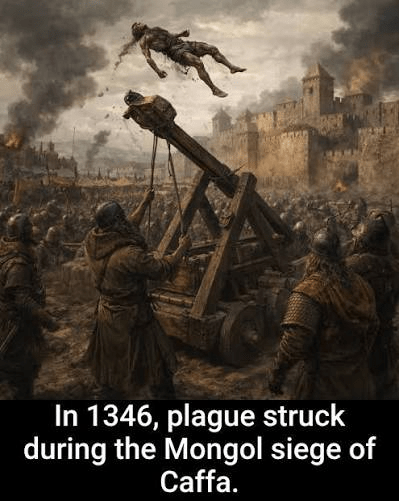
In 1910, Jack London peered into the future and penned the dystopian short story, “The Unparalleled Invasion.” At the time, London was not clairvoyant enough to envision the unleashing of WWI’s chemical and WWII’s atomic weapons, but he could imagine the use of biological weapons. Germ warfare had been in man’s arsenal throughout the ages. Some believe the Black Death plague of the fourteenth century was the result of the Golden Horde throwing plague-stricken corpses over the walls of Caffa, Crimea, in 1346.
Earlier, London had accepted an assignment by the San Francisco Examiner to cover the Russo-Japanese War. Following three arrests by the Japanese authorities for unruly behavior, he was released through the personal intervention of President Theodore Roosevelt and departed the front after six months. Nevertheless, he was able to use that experience to plot “The Unparalleled Invasion”. The storyline begins with Japan’s victory over Russia and its subsequent entry into the comity of nations. Flush with newfound imperial designs, Japan awakens the sleeping giant of China and brings it into the twentieth century. China responds and methodically grows in population from 400 million to 800 million by the American bicentennial year of 1976. It then sets out on a path of world domination. The story climaxes with the Western nations retaliating with biological weapons delivered by infected mosquitoes and destroying the Chinese population. It ends with the world outlawing biological weapons.
“The Unparalleled Invasion” has been criticized for describing genocide as the solution to the “yellow peril” and has been cited as evidence of Jack London’s racism.
Even so, London foretold many of the problems we face today. China’s population grew as predicted and has now reached 1.4 billion. China’s Communist Party does seek world domination—economically if not militarily. And in a reversal of the use of biological weapons, whether by accident or design, the rest of the world is currently under attack by a deadly virus originating from China.
The Covid 19 virus, thought by many to have originated from a Wuhan, China research laboratory, did not begin with a quiet shadow creeping across the land or infected mosquitoes. It began with infected Chinese citizens spreading from Wuhan Province and passing the disease on to the world of the twenty-first century. With a population of 1.4 billion warm bodies, perhaps the Chinese Communist Party has no need for mosquitoes to deliver its mischief. Like the Golden Horde of old, the CCP can use infected bodies to spread disease. In this case, however, the bodies are alive and can navigate to their targets on their own—whether by accident or design.
The attached manuscript by my brother Wes offers a fresh look at what makes us unique in our little corner of the universe. It is offered as a theoretical framework for scientific investigation. Wes will appreciate any feedback you have to offer.
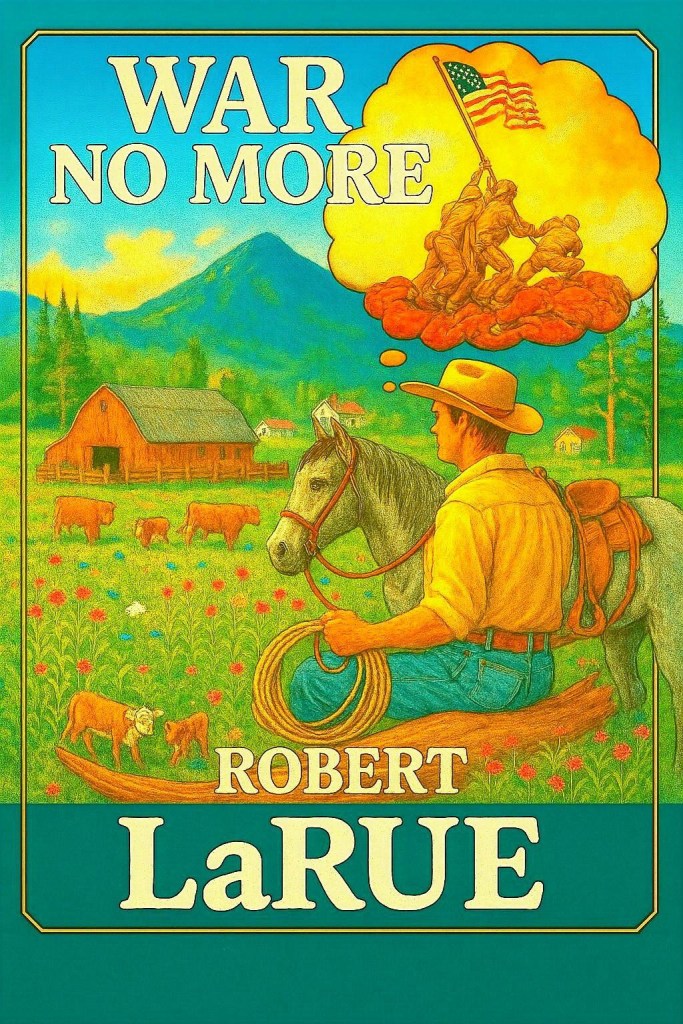
Opening Scene: Chapter 1 finds PFC Paul Harper far from home on the island of Guadalcanal in the South Pacific during World War II. Discover how he survives the perils of war and finds new life on a cattle ranch in the mountains of North Idaho.
Available on Amazon Kindle Unlimited for free, $3.99 to buy, or as a paperback, $14.99.
Paul Harper hunkered down in a shallow foxhole —his first taste of combat. The rest of his squad strung out in similar hastily dug foxholes to his left and to his right. He swatted at clouds of insects trying to eat him. He listened to sporadic gunfire raining down from the ridge above and kicking up small showers of dirt. While clinging close to the ground, he prayed silently, “Please don’t let one of those bullets find me.” He listened to the whine of mortar rounds flying overhead and exploding on the hill in front of him. The sound of screams as artillery found its mark sent shivers up his spine.
The death and destruction around him were not exactly what he had in mind when he signed up and swore to defend God and Country. This was not the larger-than-life hero’s role of protecting his country from a vicious yellow peril he had envisioned. Like thousands of fellow patriotic young men, Paul had peeled that role off a cinematic screen in two-dimensional images of black and white film. What he saw now included all three dimensions and came through in vivid living color. He was stuck on a small spit of land in the middle of the Pacific Ocean, risking life and limb to defend a ragged little airfield some fools had planted there. He could not see how this had anything to do with defending God and country. He was clear on the other side of the world.
Out of fear and confusion, Paul found an epiphany that day. Times were tough growing up during the Great Depression. His father struggled hard to keep food on the table. Like many of his neighbors in Otis Orchards, Washington, Sam Harper supplemented what the family grew in the garden and what he could afford at the grocery store with the meat of wild game from the surrounding mountains and countryside.
However, unlike the hunter-gatherers from generations past, he had to contend with game laws and hunting seasons. The age-old contest between prey and predator now held a new element. The prey now had the game warden and a network of spies and snitches to aid it in the age-old equation. Paul learned early on from his father not only how to stalk and kill wild game, but also how to do it without being seen. This was his epiphany. He had to figure out how to apply those same principles to his present predicament. He knew this from the bottom of his gut. The prey he now stalked could become the predator that would kill him if he failed to figure it out.
Paul peered over the lip of his foxhole. In front of him was an open area, cleared to expose anyone attempting to advance up the hill. Behind him and off to both sides was more of the seemingly endless deep jungle his platoon had been struggling through. The mortar rounds flying overhead and the rifle fire raining down the hill told Paul that he was directly in the line of fire between two opposing forces. He knew from training exercises that it was only a matter of time before the thump-thump of the battery behind him would cease, his sergeant would wave his arm forward, and pass the command, “Move out.” His squad would advance from the cover of the jungle and race fully exposed across the clearing. At that point, survival would have nothing to do with skill or cunning. It would simply be a matter of fate and statistics. The whole operation contradicted everything he had learned while growing up. In his world, you always maintained your cover.
At that point, Paul’s mind quit reasoning. Instinct took over. He slithered over the edge of the foxhole and crawled deeper into the undergrowth. He was back home on Mount Spokane, stalking a deer or elk. He crept through the jungle and worked his way to the right side of his platoon, off to where running water formed a small cut down the hillside. He buried himself in that shallow canyon and climbed about halfway up the hill before the rest of his platoon started its advance.
Paul looked back to his left as the platoon began its charge across the clearing. First one man, then another, and then still another fell as the main force of stooped-over running men moved forward. Medics ran out of the trees and gathered the wounded and dead as the charge continued. Paul resumed his advance, swimming and crawling up the muddy canyon. He reached the summit and dropped into the cover of jungle growth.
He watched as his platoon mates struggled up the hill against a withering rat-a-tat of machine gun and pop, pop, pop of rifle fire. He could see along the ridge where Japanese soldiers formed a line, well dug in and fortified. By now, his platoon was about halfway up the hill and stalled. Confusion reigned as the platoon lieutenant moved squads from one position to the next, trying to break through the gunfire.
Between his vantage point and the enemy line, he spotted a figure hiding in the branches of a tall tree. At first, he thought it was an animal. He shifted his position a little to get a better line of sight through the dense growth of his cover. He could now see clearly that it was a man. He watched as the spotter, sniper, or whatever he was, put something to his mouth and pointed with his free hand. Instantly, the machine guns on the hill re-aimed and chattered in rapid fire. Paul then sensed his mission. The man in the tree relayed his platoon’s every move to the machine gun battery. He had to be silenced.
Paul gauged the distance between his position and the man in the tree. He knew from hunting game that it was too great to ensure a clean kill. His father’s words came back to him. Make sure you are in a position to get a good, clean kill. The last thing you want to do is track a bleeding deer across an open snow-covered field.
He smiled a bit at the irony of the comparison. The chance of snow on Guadalcanal was about the same as the chance of snow in Hell. Even so, the principle remained the same. He did not want his quarry to spot him and give away his position. He inched forward toward the man in the tree.
At about 75 yards, Paul flattened out on the ground in a patch of tall grass. He parted the blades carefully, just enough for a clear line of sight to his quarry. He eased his rifle to his shoulder and carefully aimed from the prone position. He watched as the spotter lifted his radio microphone to his mouth, then squeezed off a single round. Instantly, the radio went flying and crashed to the ground. The man stretched and shuddered for an instant, then tumbled through the branches until some combination of limbs caught him, and he just hung there. Paul beat a hasty retreat to his hiding place, knowing that the enemy would be all over the place as soon as they realized they had lost their spotter.
Without the spotter’s eyes and ears for guidance, the machine guns quickly lost their effectiveness. Paul’s platoon promptly took advantage of the situation, and soon soldiers were pouring over the crest of the hill. Rifles fired, grenades exploded, bayonets thrust, and in short order, the hill’s ownership transferred to American hands. A squad of Americans advanced toward three Japanese soldiers milling around under the tree where the dead spotter hung. It was not Paul’s squad, but he unobtrusively joined in as the Americans overwhelmed and disarmed the Japanese. One of the Americans spotted the man hanging from the tree in a Japanese uniform with his head blown partly away, said, “What in the hell is that?”
“Looks like a Jap with his head half blown off,” another soldier said.
The squad leader, a battle-hardened sergeant, looked up. “Appears to me that somebody got himself a spotter here,” he allowed. He looked around and riveted Paul with a steady gaze. “Would that be you, Private?”
“Yes, Sergeant,” Paul answered.
“What the hell were you doing here? Where’s your outfit, and why aren’t you with them?”
“Well, I saw this guy in this here tree signaling somebody when we were pinned down on the hill down yonder, and so I just snuck up on him and shot him.”
“And just who in the hell told you to do that?”
“Well, actually, nobody. I just kinda did it.”
“Okay, Private, I don’t know whether to put you on report or pin a medal on you. I’ll let your squad leader decide about that. For right now, we need to get this pile of shit bunch of gooks over there with that other bunch of bastards we captured this afternoon. Move ’em out, men.”
News travels fast. When Paul rejoined his squad, his exploits were already general knowledge. His squad leader, Sergeant Kelly, first dressed him down for getting lost from his comrades and then congratulated him on his kill. His platoon leader, ninety-day-wonder master of eloquence Lieutenant Pringle, singled him out for “exhibiting unusual personal initiative in the face of danger by taking out a strategic member of the enemy force single-handedly” in front of the whole platoon when they camped that evening. The fact that he had managed to keep himself out of the line of fire was enough for Paul. The accolades were gravy. He knew he could just as well be receiving reprimands. A favorite platitude among the troops was “There’s a right way, a wrong way, and the Army way.” Paul Harper was beginning to understand what it meant.